
A wooden, painted, woven-front, or metal-framed dresser can all work with an iron bed. Choose one shared detail—such as black handles, a warm wood finish, or curved lines—then check that the dresser provides the storage and clearance your room needs. You do not need a matching bedroom set.
The eleven options below show practical combinations, including a tall chest when wall width is limited. Wardrobes, armoires, and garment racks are covered separately because they store clothes differently. The bedroom pictures are illustrative styling examples, not photographs of tested products.
Finding the Right Dresser for an Iron Bed
Start with the bed’s visible finish and shape. Black, white, bronze-toned, and brass-finish metal beds can work with several dresser finishes. Metal does not automatically make a bedroom look cold, and a dresser does not have to match the frame exactly.
Take photographs of the bed in daylight and compare finish samples where possible. You do not need to dismantle the bed to carry a piece to a store. Look for a repeated detail in the dresser hardware, legs, or trim, then compare the combination with your bedding and flooring.
| Your bed | Dresser to try | Detail to repeat |
|---|---|---|
| Black or dark metal | Cream paint or warm wood | Dark knobs or legs |
| White metal | Natural wood or charcoal paint | White bedding or a pale lamp |
| Brass-finish metal | Navy paint or warm wood | Brass-finish pulls |
| Curved, ornate frame | Plain drawer fronts | One repeated curve or finish |
| Straight, simple frame | Wood and metal or woven fronts | Similar legs or hardware |
Compare the Eleven Dresser Options
These categories overlap: a wooden dresser can also be painted or have a metal base. Use the comparison to choose the feature you need most, then compare actual dimensions. A tall chest is a narrower storage alternative, not a horizontal dresser.
| Option | Choose it for | Check before buying |
|---|---|---|
| Solid-colored | A simple backdrop for a decorative bed | Paint finish and usable drawer sizes |
| Rustic painted | A cottage-style pairing or an existing piece to reuse | Drawer condition, joints, and coating before refinishing |
| Classic wood | Visible grain and contrast with the metal frame | Actual material: solid wood, veneer, or printed finish |
| Accent | A stronger color or patterned focal point | Real clothing drawers, rather than cabinet shelves |
| Woven-front | Texture beside smooth bed rails | Smooth drawer interiors and sound woven panels |
| Wood with metal frame | Repeating black metal legs or bed details | Full base footprint, connections, and load limits |
| Tall chest | Less available wall width | Upper-drawer reach, usable capacity, and open-drawer space |
| Mid-century modern | Tapered legs and simple lines | Leg spread, usable drawers, and veneer condition |
| Mirrored | Reflection beside a dark or brass-finish bed | Panel edges, care instructions, and delivery-damage policy |
| Two-tone | Connecting wood and paint colors already in the room | Actual surface materials and finish samples |
| Traditional | Echoing curved rails or scrollwork | Deepest part of the shaped front and projecting pulls |
If floor space is tight: compare a shallow horizontal dresser with a tall chest. A narrower cabinet does not necessarily project less into the room, so check depth and drawer extension separately.
If you already own a dresser: try repeating the bed’s finish in compatible drawer pulls or a lamp before replacing the furniture. If two people share storage: compare usable drawer dimensions and how each person will access them; drawer count alone does not show capacity.
1. Solid-Colored Dresser
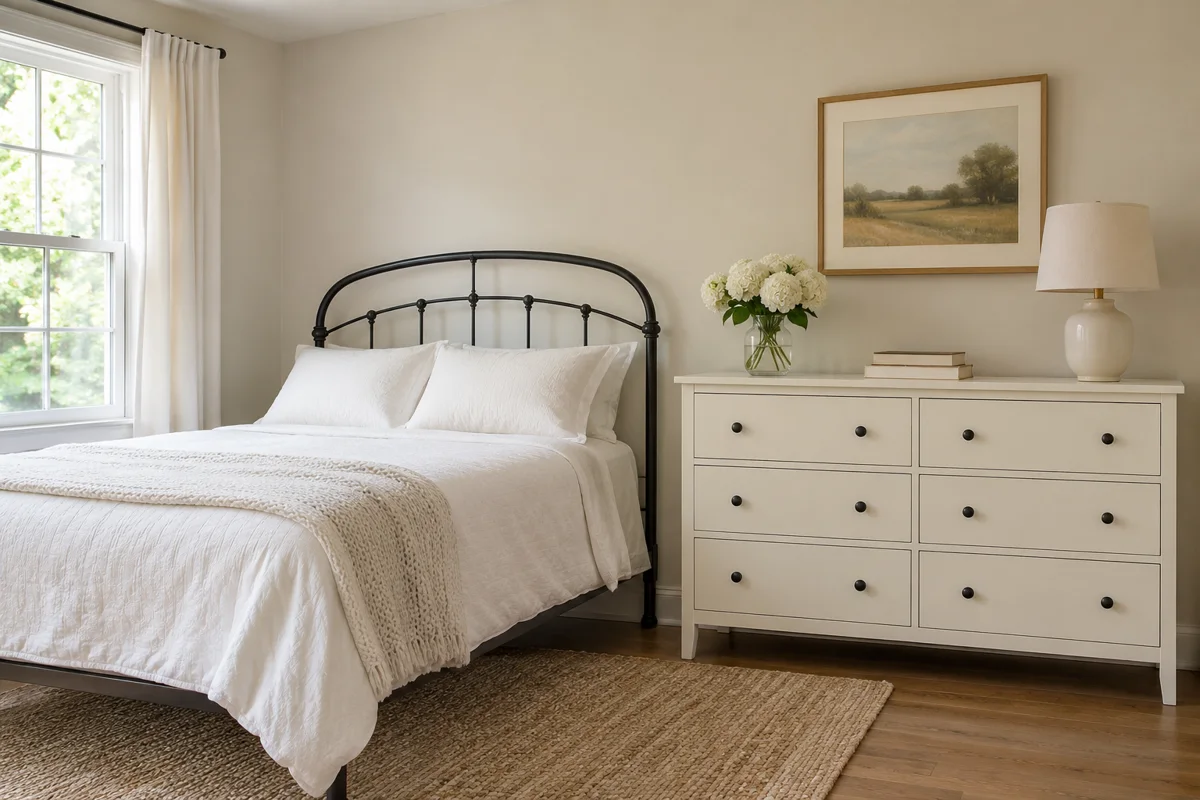
A plain painted dresser is a useful starting point when the bed has curved rails, decorative scrolls, or a canopy. White, cream, charcoal, and black can all work; choose the contrast you want rather than trying to match every piece.
For a black bed, try a cream dresser with black pulls. For a white metal bed, a charcoal dresser can provide contrast while white bedding repeats the frame color. Compare paint samples or finish swatches in daylight and under your bedroom lamps.
A low, wide dresser also provides a surface for a lamp or framed photographs. Check the top’s load limit and leave enough usable space for the items you actually keep there. A product described as a painted wood finish may be coated engineered wood rather than solid timber.
2. Rustic Painted Dresser
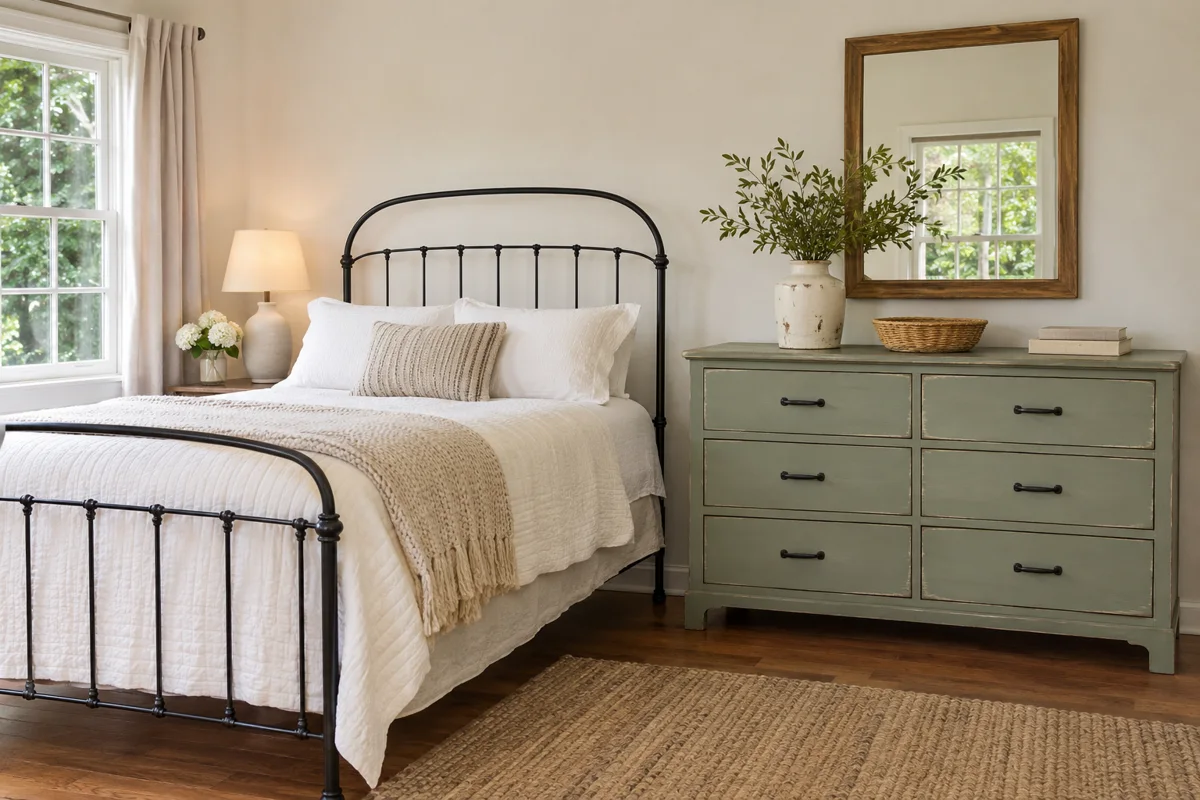
A painted dresser with simple molding or a lightly distressed finish can suit a curved iron bed. Sage, muted blue, cream, or a deeper accent color are options; rustic furniture does not have to follow one fixed palette.
Repeat one detail, such as black handles beside a black bed, then use bedding to connect the colors. If you already own a dresser, new compatible pulls may create that connection without repainting it.
For a used piece, inspect drawer bottoms, joints, runners, odors, and the back before buying. Do not sand an unidentified old painted finish without checking how to handle that coating appropriately. Small chips in a finish and loose structural joints are different problems.
3. Classic Wooden Dresser
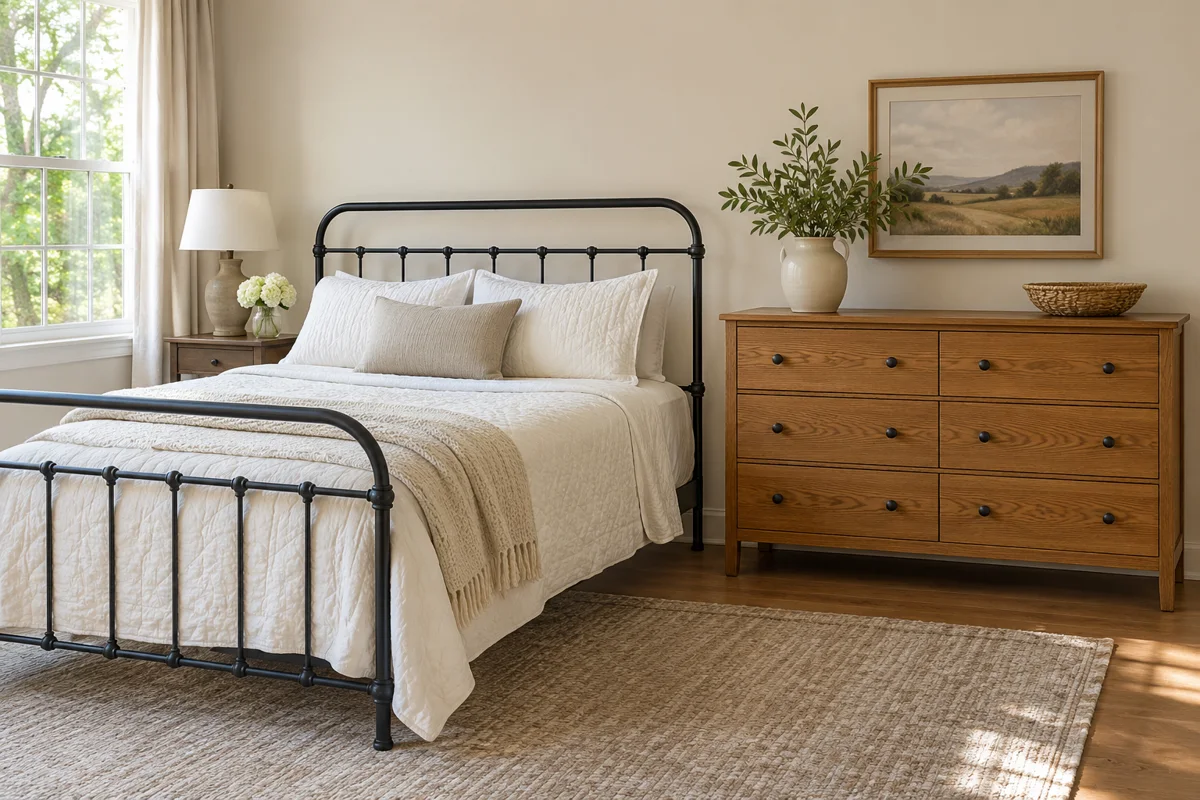
A wooden dresser gives you a visible grain pattern beside the bed’s metal rails. Light oak, walnut-toned finishes, cherry, and painted wood can all coordinate with an iron bed; no wood species requires a particular metal color.
Compare the actual finish rather than relying on a name such as oak or walnut. Those words can describe solid wood, veneer, or a printed finish. A golden oak dresser with black knobs can work with a black bed, while a darker dresser can provide contrast against a white frame.
Check drawer construction and usable inside dimensions as well as the overall width. A deep-looking cabinet may have shallow drawers. Our guide to mixing wood furniture in a bedroom explains how to repeat undertones without buying a matching set.
4. Accent Dresser
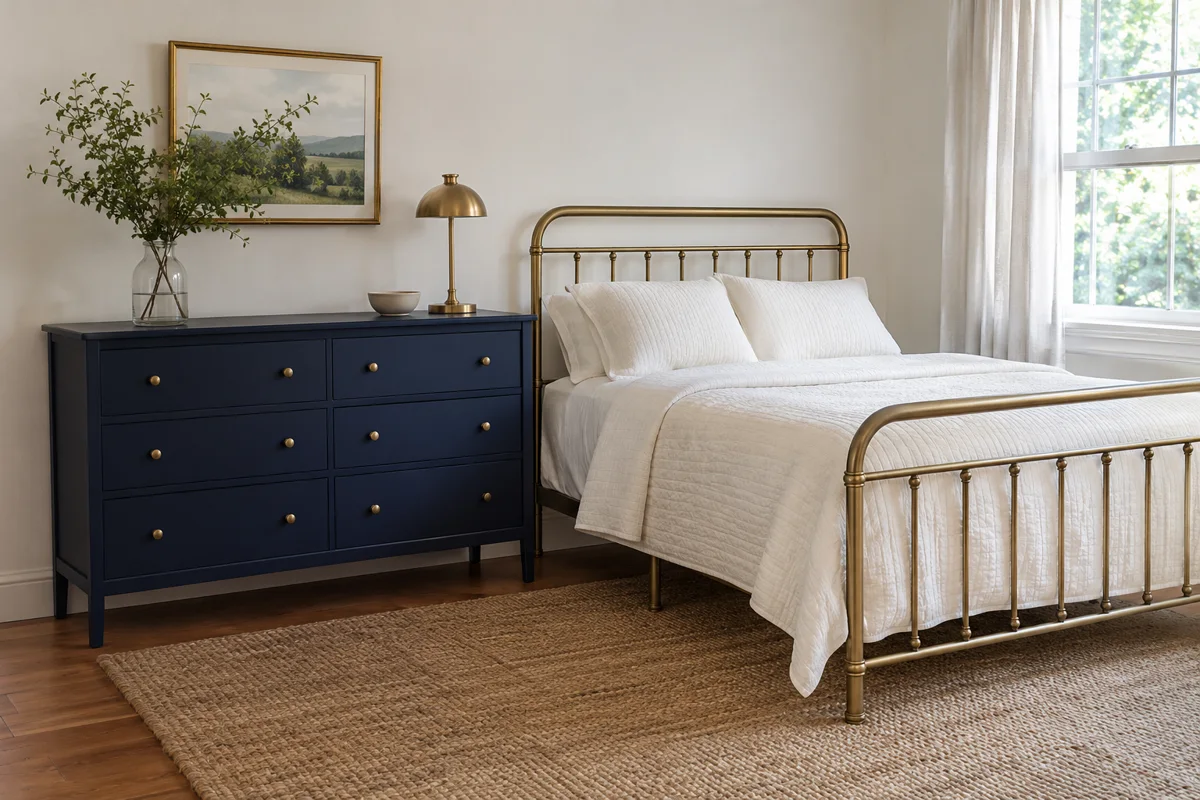
An accent dresser uses a noticeable color, patterned drawer fronts, or decorative hardware. It can share attention with the bed; the bed does not always need to be the room’s main focal point.
For example, pair a navy dresser with a brass-finish bed and repeat brass in the drawer pulls. If both the bed and dresser are ornate, try quieter bedding before deciding that either piece needs replacing.
Check that an accent cabinet is intended for clothing storage. A hallway cabinet with shelves is not the same as a dresser with drawers, even if a retailer places both in bedroom photographs. Inspect the actual drawer layout before ordering.
5. Woven-Front Dresser
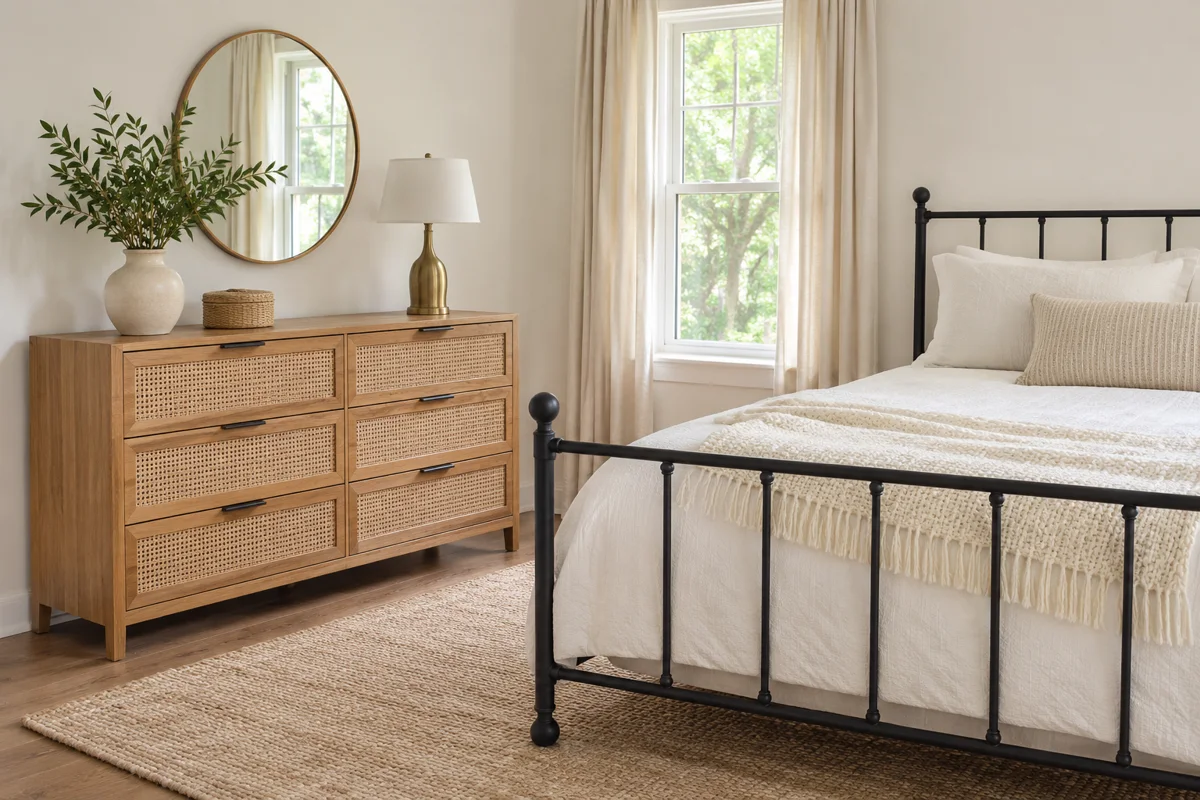
A dresser with cane or woven panels brings texture to a room with smooth metal rails. Look for a proper drawer box behind each woven front if you want enclosed storage for folded clothes.
A wicker basket shelf is a different storage option: baskets may have smaller openings, rougher interiors, and less enclosed protection. Check the inside measurements and whether delicate fabrics need a smooth liner.
On a cane-front dresser, inspect panel edges, drawer alignment, and the manufacturer’s care guidance. Keep the piece within the recommended indoor conditions; decorative woven material does not automatically make the whole dresser suitable for damp rooms or outdoor use.
6. Wood Dresser With a Metal Frame
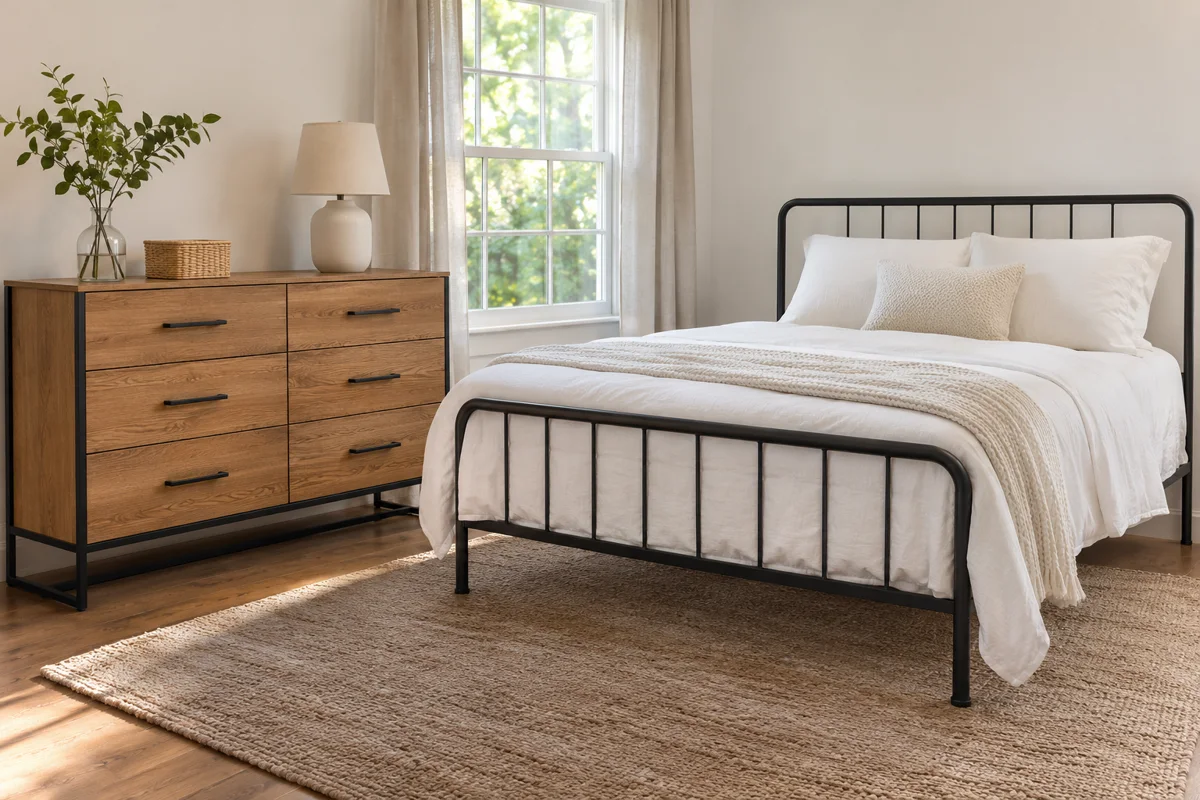
Dressers can have metal frames. A wood cabinet supported by a black metal base is one way to repeat the bed’s finish without making every surface metal.
This pairing suits a straight-lined bed particularly well, but it can also provide contrast beside a curved frame. Compare the base’s full width and depth, including projecting feet; the cabinet dimensions alone may not describe the full footprint.
Check the drawers, frame connections, leveling instructions, and load limits. An open base may make floor cleaning easier, but it does not establish the piece’s strength or stability. Use the specified anti-tip restraint.
7. Tall Chest of Drawers
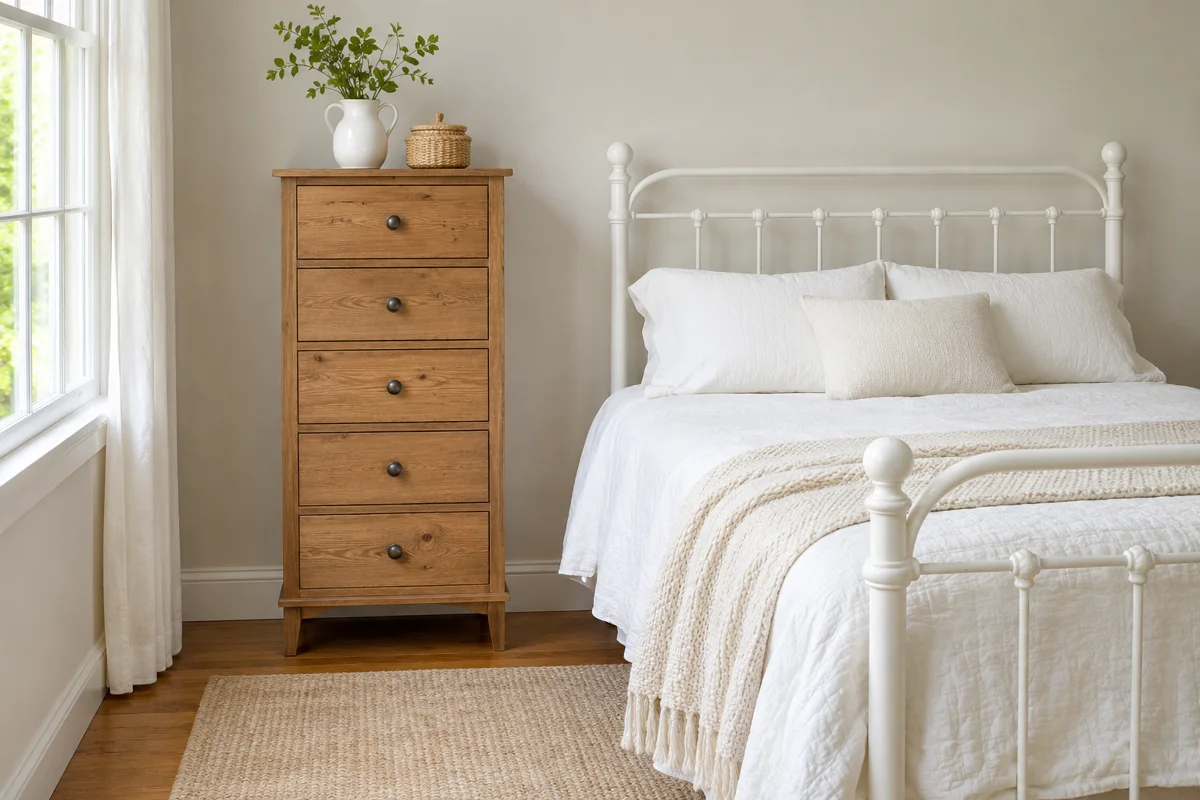
If a wide dresser will not fit, a tall chest of drawers is a related alternative for folded clothing. Retailers sometimes group it with dressers, but a chest is generally taller and narrower than a conventional horizontal dresser.
A wood chest can contrast with a white iron bed, or a dark painted chest can repeat a black frame. Choose it for the storage and wall space you have rather than assuming that taller means more usable capacity.
Measure the inside drawers and check whether you can reach the upper ones comfortably. Allow access to the wall for the manufacturer’s anti-tip installation. See chest versus dresser before choosing between the two layouts.
8. Mid-Century Modern Dresser
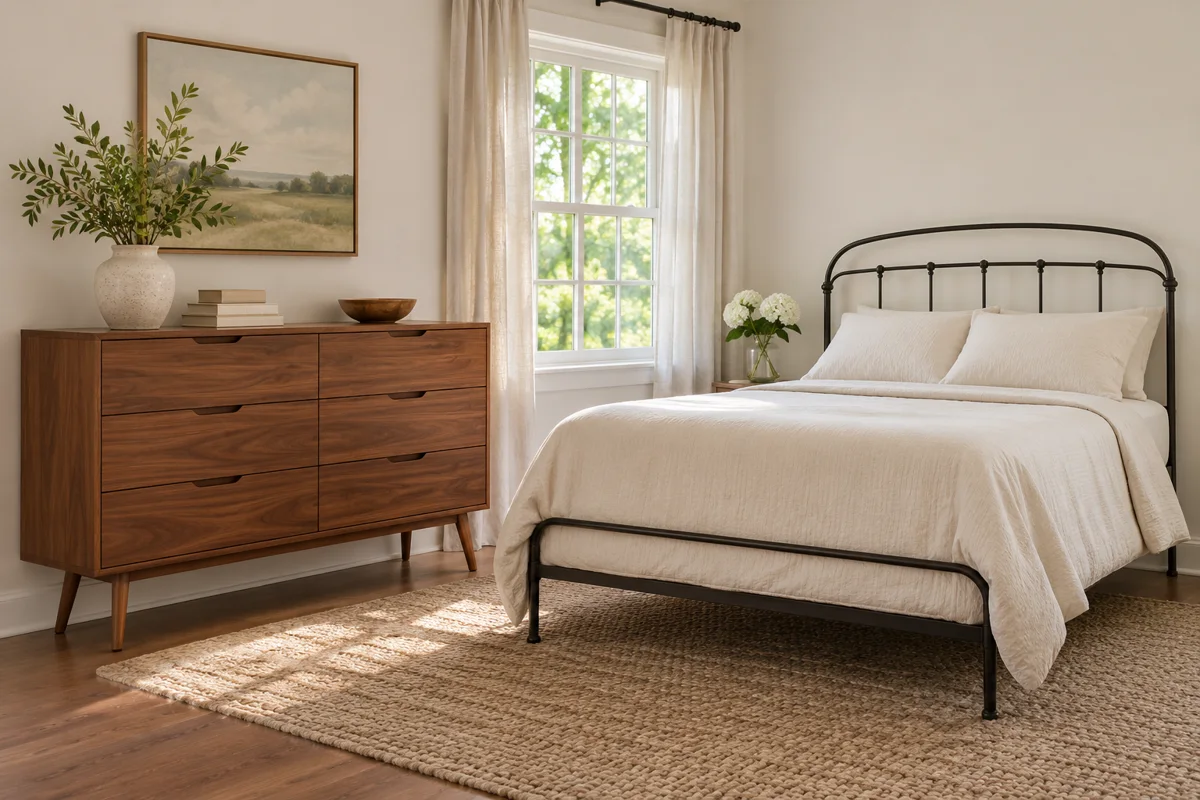
A mid-century modern dresser adds straight lines and raised, tapered legs beside a metal bed. A walnut-toned cabinet can contrast with a black frame, while lighter wood can work with a white painted frame. The bed and dresser do not need to come from the same design period.
Look for a useful balance of drawer space and footprint. Raised legs can leave room for cleaning underneath, but their height does not tell you how much clothing the drawers hold. Measure the usable drawer interiors and the widest part of any angled legs.
For a vintage piece, check the leg attachments, drawer runners, veneer edges, and availability of replacement hardware. For a new piece, follow its assembly and anchoring instructions. The picture is a styling example rather than a recommendation for a particular product.
9. Mirrored Dresser
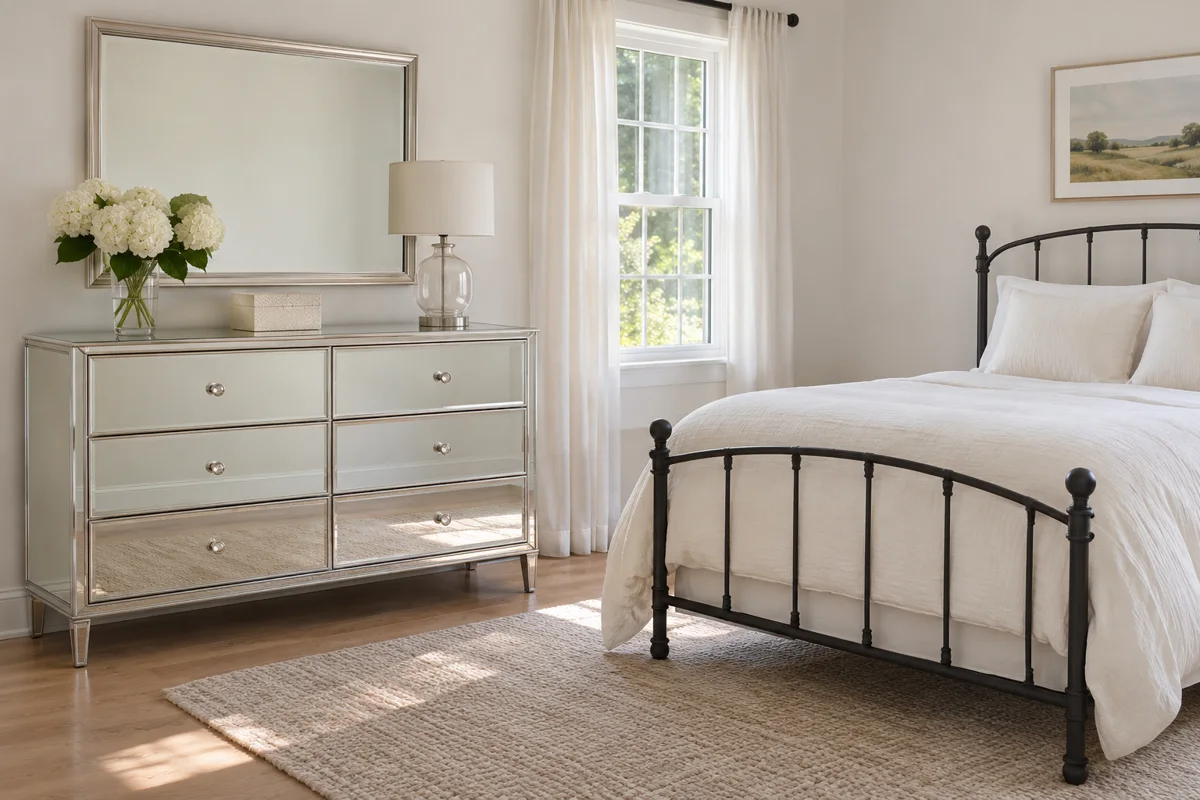
A mirrored dresser can introduce reflection beside a dark iron frame or a brass-finish bed. Try a simpler outline if the bed already has elaborate scrollwork. You can repeat the dresser’s trim in a lamp or picture frame without matching every metal in the room.
Check what the fronts will reflect from the doorway and the bed: a window, a plain wall, or a busy storage area. Reflection does not create extra floor space, so use the same open-drawer measurements you would for a wood dresser.
Before buying, inspect the mirrored panel edges and ask about damaged-delivery claims and replacement panels. Read the care instructions for both the glass and its surrounding finish. Confirm that it has clothing drawers; a dresser mirror sold separately is not a mirrored dresser.
10. Two-Tone Dresser
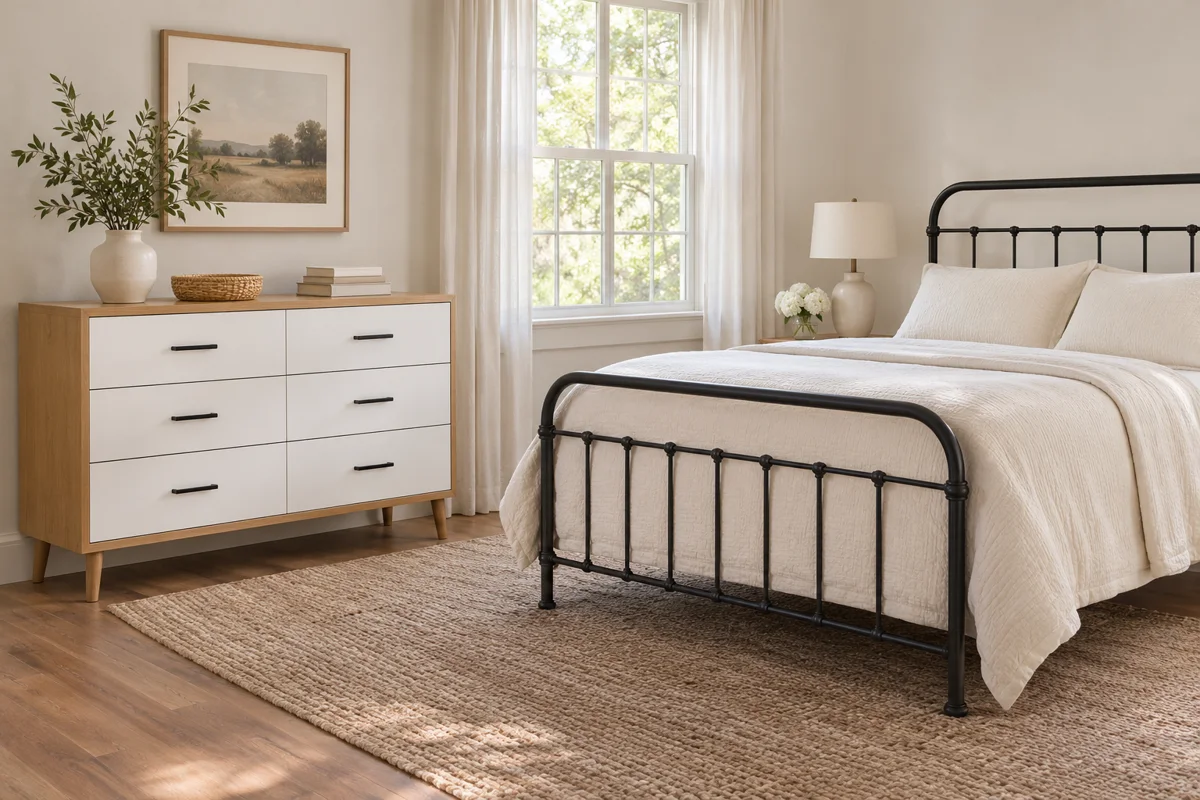
A two-tone dresser combines contrasting finishes, such as white drawers in an oak cabinet or a dark cabinet with lighter wood fronts. It can connect two colors already in the room rather than introducing a completely new palette.
For a black iron bed, try wood and cream with black pulls. For a white bed, repeat the white in the drawer fronts and let the surrounding wood provide contrast. Compare samples in your room because product photographs can make both paint and wood look warmer or cooler.
If you plan to create the look on a dresser you own, identify which surfaces are solid wood, veneer, laminate, or an existing coating before choosing preparation and paint. Changing compatible pulls is a smaller first step. Repainting a surface does not change the drawer construction or repair loose joints.
11. Traditional Dresser
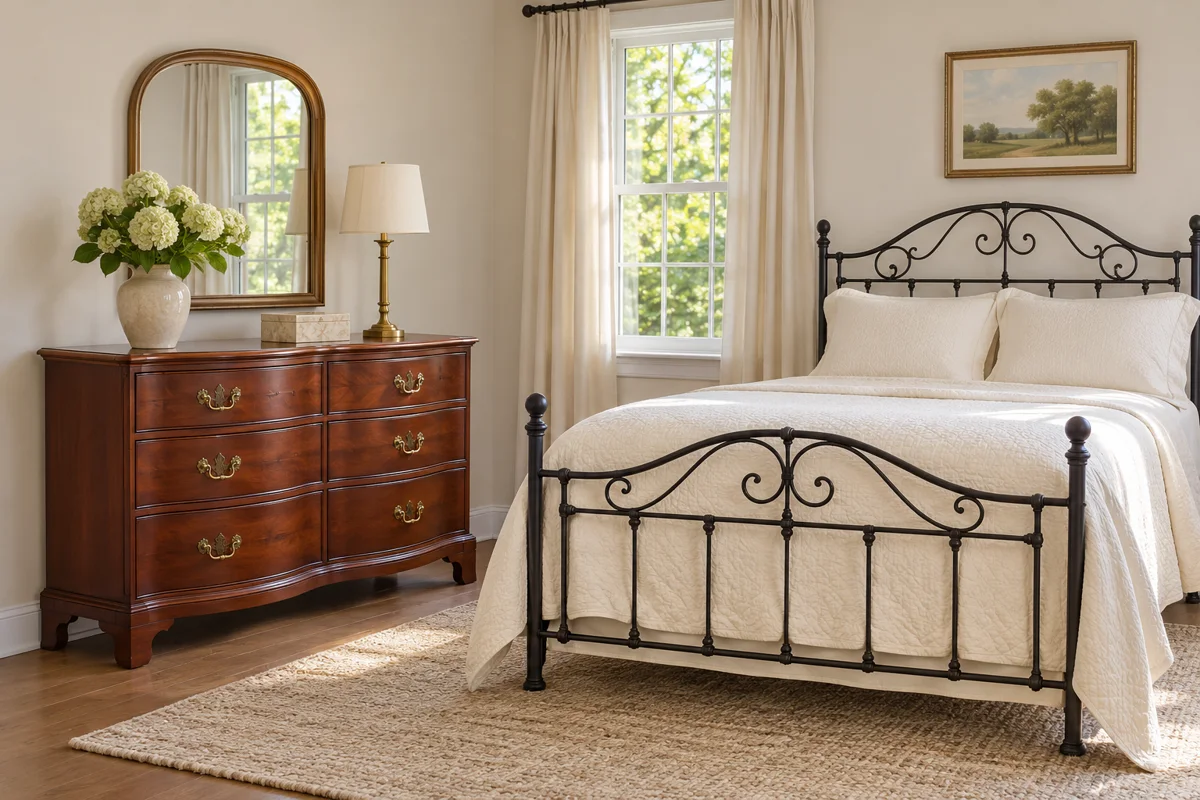
A traditional dresser can echo the curves of an ornate iron bed through a shaped front, molding, or decorative pulls. A cherry-toned dresser beside a black scrollwork frame is one example; pale painted traditional furniture can also work.
Keep the details you enjoy, then use bedding and accessories to control how busy the combination feels. There is no rule that only one piece may be ornate. Compare the overall scale so the dresser leaves room to use the bed comfortably.
Measure at the deepest part of a bowed or serpentine front, including the pulls. A dimension measured only at the cabinet’s sides can miss the projecting center. Check drawer extension, the delivery route, and whether decorative feet extend beyond the cabinet.
Measure the Dresser With the Drawers Open
Measure the distance from the wall to the nearest part of the bed frame, not just to the mattress. Include the dresser’s full depth, projecting handles, any gap required behind it, and the extra space used by an open drawer.
Worked example: suppose there are 54 inches from the wall to the bed frame. A dresser and its required rear gap occupy 20 inches, leaving 34 inches with the drawers closed. If a drawer projects another 14 inches when open, only 20 inches remains. That may be awkward to stand in or pass through. Test the space with tape and a box before ordering; this calculation is a fit check, not an accessibility standard.
Measure the delivery route too: door openings, hallway turns, stairs, and the largest packaged or assembled part. Confirm whether assembly and room delivery are included. Two pieces with the same drawer count may have very different usable capacity.
What to Check Before Buying
Read the listing beyond the finish name. Compare outside dimensions, inside drawer width/depth/height, drawer extension, load limits, assembly instructions, and the material of the cabinet and drawer bottoms. Check shipping, returns, and whether handles and the required anchoring parts are included.
Plan the wall attachment. Follow the furniture instructions and choose hardware appropriate for the wall construction. The CPSC Anchor It! campaign recommends anchoring furniture with drawers, doors, and shelves to help prevent tip-overs. New furniture and low, wide dressers still need the specified restraint. For used furniture, also check the model against CPSC recalls.
If changing handles: measure the distance between the existing screw holes and check screw length against the drawer-front thickness. Matching the bed’s exact metal is optional; a compatible finish and usable grip matter more.
Other Clothing Storage: Wardrobes, Armoires, and Racks
A wardrobe or armoire is useful when you need hanging space rather than mostly folded storage. The terms overlap; an armoire is not automatically larger or more decorative. Compare the actual hanging rail, shelves, doors, and drawers. A pantry cabinet should not be treated as a wardrobe without checking its intended use and interior fittings.
Sauder’s wardrobe and armoire category shows how these layouts differ. Check the exact model’s rail height, inside depth, door swing, and anchoring instructions instead of assuming every finish or size is available.
An open garment rack can hold planned outfits, but it does not replace enclosed drawer storage. Measure its full footprint, check its rated load and stability, and account for clothes extending beyond the rail. Match the metal finish if you like, then keep drawers or bins for items that need them.
How to Style the Rest of the Room
Repeat one dresser or bed color in the bedding, curtains, or a lamp. A quilt, throw, or woven rug can add texture beside smooth metal rails. You can keep the rest of the room quiet or include stronger patterns; the amount of decoration is a preference, not a rule about what makes a bedroom restful.
For reading in bed, use a suitable backrest cushion if the rails are uncomfortable, and keep it clear of gaps where it cannot sit securely. Place an accent chair, bookshelf, or vanity only if the floor plan leaves usable access to the bed and drawers.
A mirror can repeat the bed’s metal finish or use a contrasting wood frame. Mount it with hardware suitable for its weight and the wall; do not assume a heavy mirror can safely lean on a dresser.
Two Related Guides
Do bedroom sets have to match? helps you decide what to repeat across the room. For the piece beside the bed, see nightstand styles and storage options; compare the finish with your iron frame rather than copying a whole set.